

MOTS-c | 40mg | 3ml
MOTS‑c is a synthetic version of a naturally occurring mitochondrial‑derived peptide encoded within the 12S rRNA region of mitochondrial DNA. In research environments, it is used to explore mitochondrial signalling pathways, metabolic regulation, and communication between the mitochondria and nucleus. In biochemical and cellular models, MOTS‑c has been shown to influence intracellular pathways tied to energy sensing, insulin‑related signalling, and cellular stress adaptation. Experimental systems often assess its impact on AMPK activation, metabolic gene regulation, and stress‑responsive signalling cascades. The molecular effects observed vary according to concentration, exposure time, and the specific model used.
Strength
40mg
Concentration
13.33 mg/ml
Purity
≥99% HPLC
COA
Included
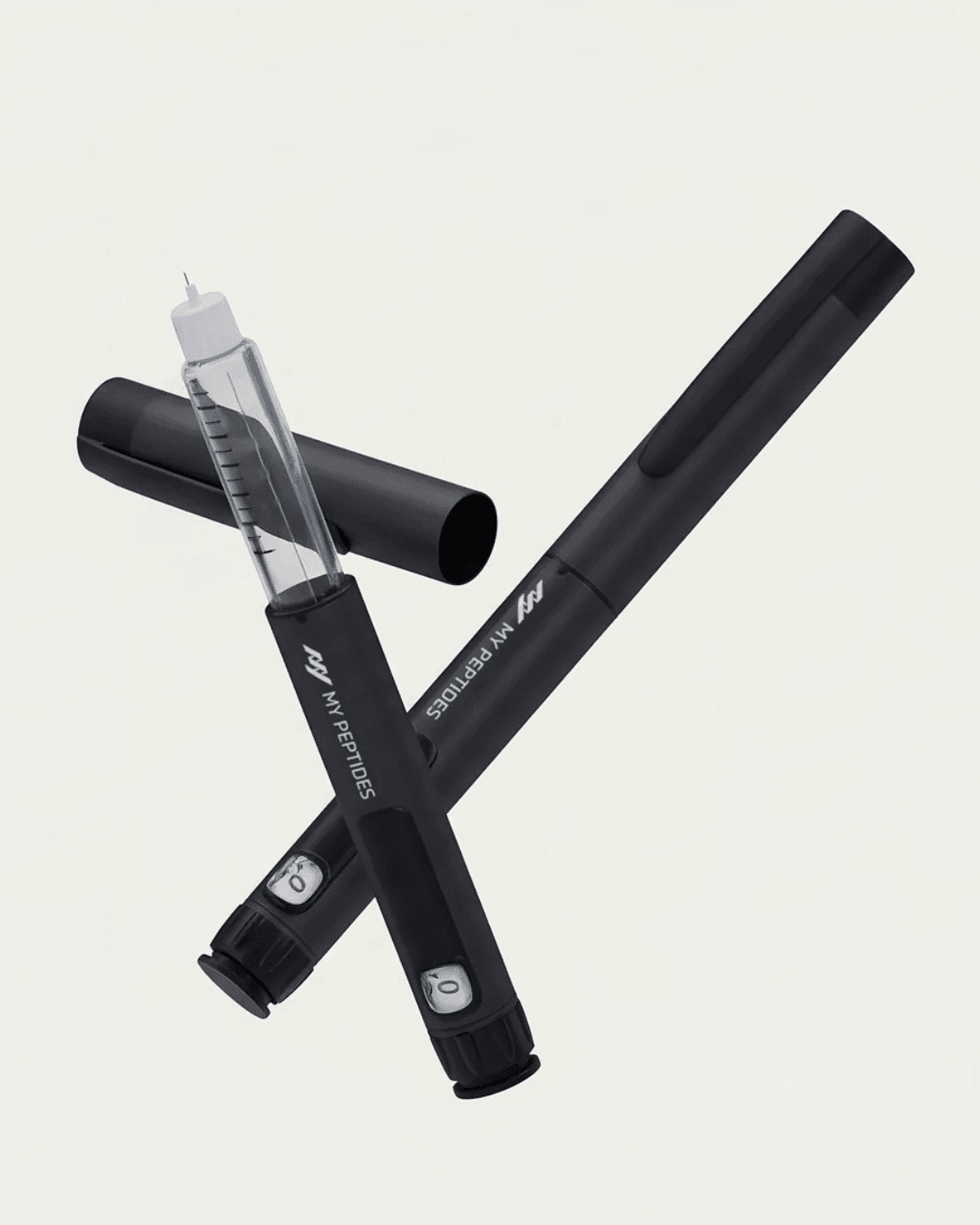
Free Reusable auto-injector pen, worth $50
A reusable pen is added free to your order, automatically.
- Free shipping within the United States over $100, tracked.
- Cold-chain packed: sealed foil pouch, ice packs, plain outer box.
- Batch-specific Certificate of Analysis included.
| Designation | Mitochondrial-derived peptide |
| CAS Number | 1627580-64-6 |
| Molecular Formula | C₁₀₁H₁₅₂N₂₈O₂₂S₂ |
| Molecular Weight | 2174.6 g/mol |
| Sequence | Met-Arg-Trp-Gln-Glu-Met-Gly-Tyr-Ile-Phe-Tyr-Pro-Arg-Lys-Leu-Arg |
| Strength | 40mg |
| Concentration | 13.33 mg/ml |
| Presentation | 3ml vial |
| Purity | ≥99% (HPLC) |
| Certificate of Analysis | Batch-specific COA included |
How we ship it
Every pre-mixed vial ships cold from the warehouse serving your region and arrives in a plain box. Refrigerate on arrival at 2–8 °C.
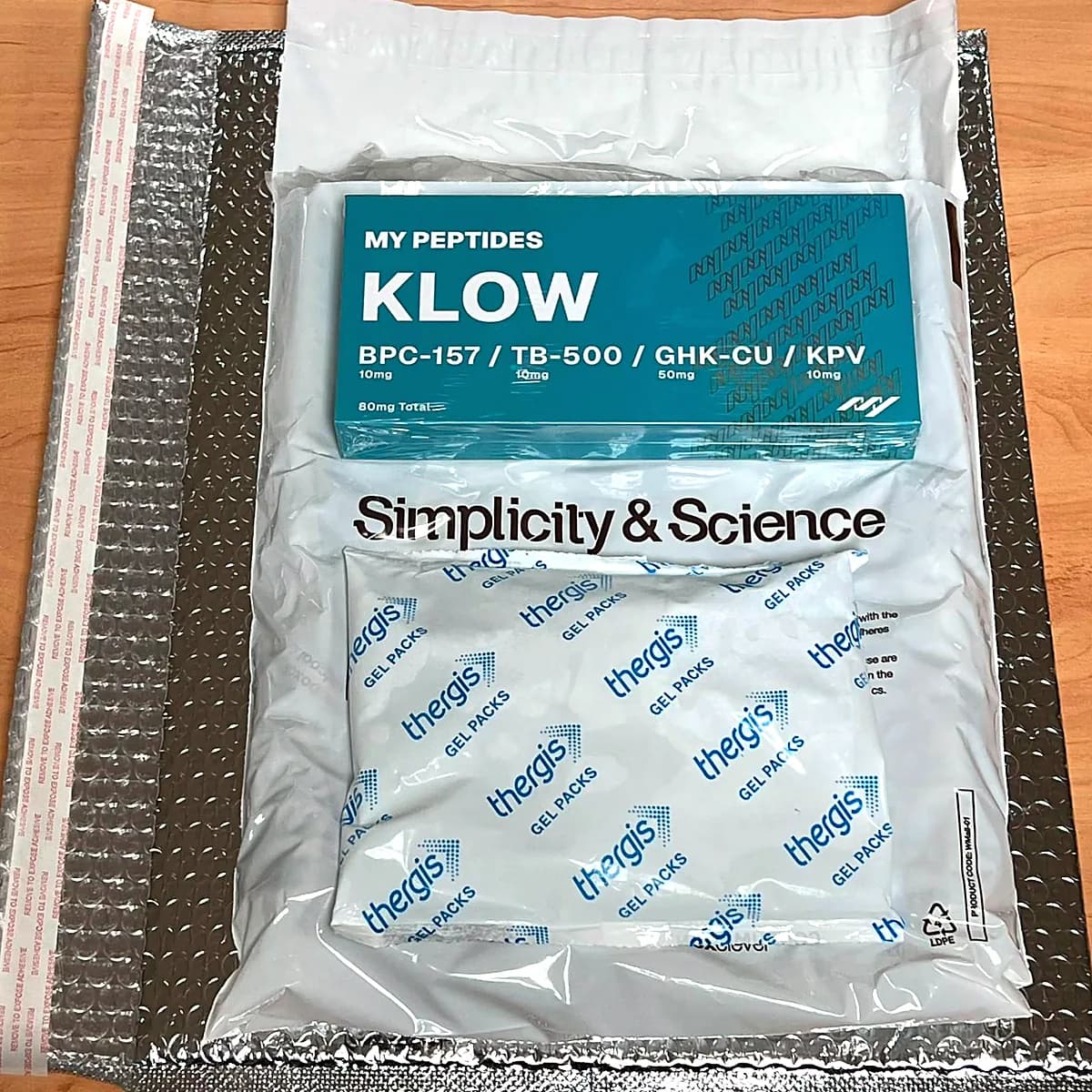
Chilled
Vials travel with frozen gel packs inside a sealed foil pouch, which holds temperature for roughly seven days — far longer than the journey needs, so the cold chain has room to spare.
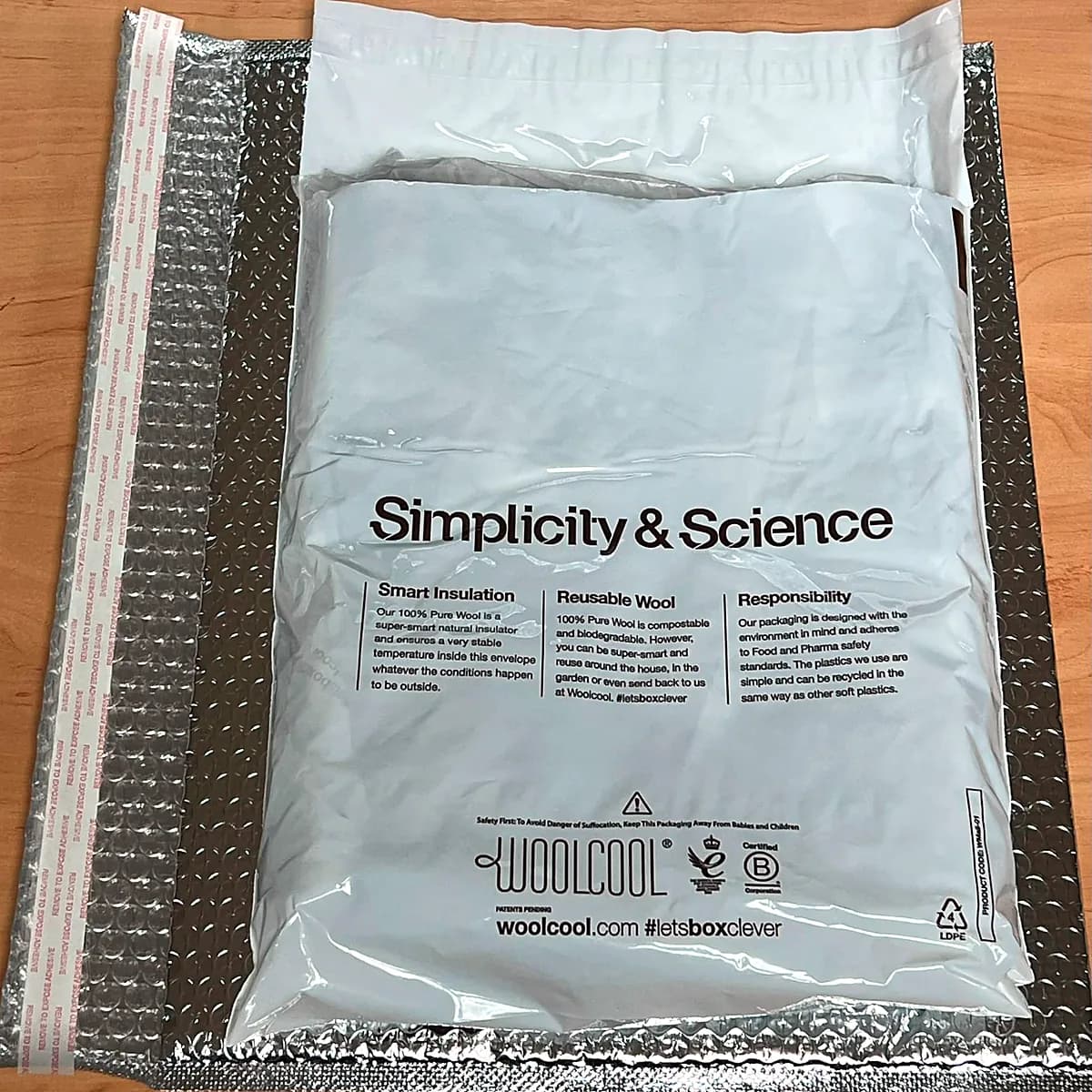
Insulated
The pouch sits inside a wool-lined envelope, so the cold chain survives a normal courier journey.
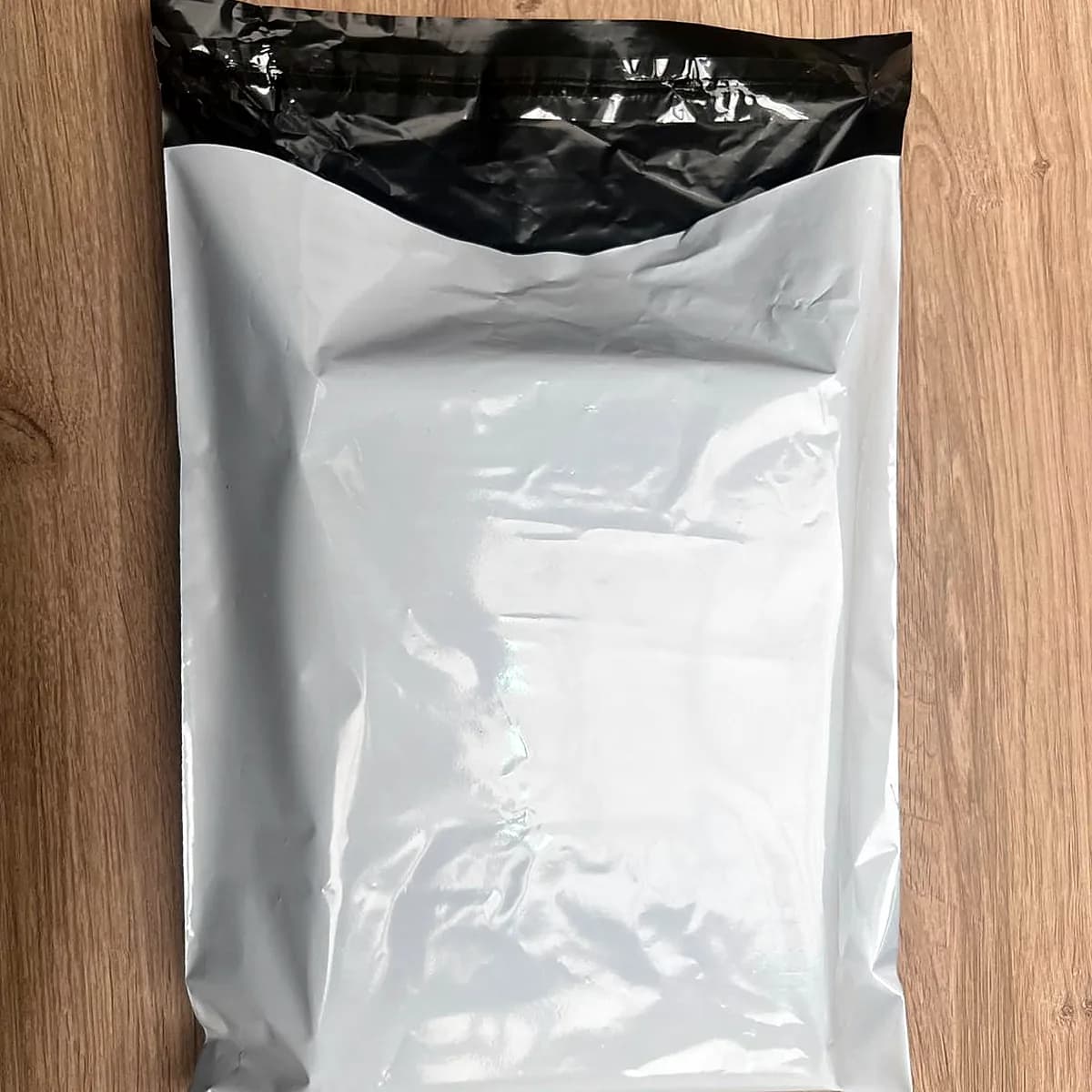
Discreet
Plain outer box with no branding and nothing on the label that names the contents.
Same-day dispatch
Order before the daily cut-off, Monday to Friday.
Free over $100
Within the US: tracked, next business day.
2–8 °C on arrival
Refrigerate as soon as the parcel lands.
MOTS-c: chemistry, identity checks and format trade-offs for US laboratory buyers
MOTS-c is a 16-amino-acid mitochondrial-derived peptide (MDP), encoded by a short open reading frame sitting inside the 12S rRNA region of mitochondrial DNA rather than in the nuclear genome — the structural fact that defines the MDP class and separates it from the nuclear-encoded peptides that make up most of a research catalog. What is supplied here is the synthetic sequence, not material isolated from tissue.
${RUO_NOTE}
Reading the sequence like an analyst
The sequence is MRWQEMGYIFYPRKLR, giving an average mass near 2,175 Da for the unmodified peptide. Four features of that string determine most of what a receiving laboratory will see on its own instruments:
- Two methionines, at positions 1 and 6. Methionine sulfoxide formation is a known degradation route for a sequence carrying two of them. It shows on mass spectrometry as a +16 Da satellite and on reversed-phase HPLC as an earlier-eluting shoulder. If you run one incoming check, run that one.
- A tryptophan at position 3, plus tyrosines at 8 and 11. These give a real 280 nm chromophore, so UV quantitation is meaningful rather than an approximation. Tryptophan is also photosensitive, which is why amber glass and dark storage are functional requirements, not packaging aesthetics.
- No cysteine anywhere in the chain. There is no disulfide to scramble and no free thiol to dimerize, which removes an entire failure class that complicates many other research peptides.
- Three arginines and a lysine against a single glutamate. Net charge is strongly basic, so the peptide behaves predictably under ion-pairing reversed-phase conditions and lends itself to cation-exchange as an orthogonal identity check. The glutamine at position 4 carries the ordinary deamidation risk — a +1 Da shift that low-resolution instruments miss.
Because MOTS-c is encoded mitochondrially, the published literature around it sits mostly in the study of mitochondrial-to-nuclear ("retrograde") signalling and cellular energy-sensing pathways. Those are fields of inquiry, not descriptions of what this material does. The work in them is a body of in-vitro and animal laboratory research under examination, and nothing on this page should be read as drawing conclusions from it.
Why a number on the label is not one number
A vial marked 40mg is describing peptide mass — but synthetic peptides do not arrive as pure peptide by weight. A basic sequence like this one is commonly isolated as a salt, and the counter-ion occupies real mass. So does bound water, which lyophilized material picks up readily. For a peptide carrying four basic residues, the combined counter-ion and moisture fraction is not trivial.
That produces the mismatch worth catching first: gross peptide weight versus net peptide content. Ask any supplier, ours included, which figure their label states, and by what method the net figure was established — amino acid analysis and quantitative nitrogen determination are defensible; back-calculating from an HPLC area percentage is not. Purity and content are separate questions, and a certificate that answers only the first has answered half.
Two formats, two failure modes
Research peptides reach a bench in one of two states: as a lyophilized solid, or as a solution filled and sealed upstream. Neither is universally correct, and the useful way to think about them is that they fail differently rather than that one is standard. Confirm which state a given lot ships in — from any supplier, ours included — before you plan the receiving work, because the checks below are not interchangeable.
| Consideration | Lyophilized solid | Solution filled upstream |
|---|---|---|
| Gravimetric step at your bench | Required; small masses of hygroscopic solid are a large source of preparation error | Removed — the fill is done once, upstream |
| Consistency across a long study | Depends on your own repeat reconstitutions | Fixed within a batch |
| Transit exposure | Tolerant of temperature excursions in the parcel network | Spends the whole journey in solution; supplier packing method matters more |
| Oxidation risk | Lower in the dry state | Higher, methionine-driven; headspace and light control are the mitigations |
| Freeze–thaw | Not applicable until reconstituted | Real; aliquot on arrival rather than cycling one container |
| Verification on receipt | You can weigh, dry and assay independently | You verify by analysis of the solution, not by mass |
| Storage footprint | Compact, long dry shelf life | Bulkier, shorter practical window once opened |
Where material arrives already in solution, the weighing arithmetic moves off your bench and onto the supplier's fill process. That is a genuine convenience and a genuine transfer of trust, which is the honest way to frame the trade-off. If your workflow depends on preparing your own buffer systems or solvent matrices, a solid is the more flexible starting point. If your variance problem is operator-to-operator preparation across a multi-month protocol, a single upstream fill is the tighter control.
What a certificate of analysis should contain
| Section | What it establishes | What to look for |
|---|---|---|
| RP-HPLC chromatogram | Chromatographic purity | The full trace, not a bare percentage; check the baseline and any shoulder before the main peak |
| Mass spectrometry | Molecular identity | Observed mass consistent with the calculated value for the 16-mer; look for +16 Da and +1 Da satellites |
| Amino acid analysis or sequencing | That it is this sequence, not a same-mass alternative | Its absence means identity rests on mass alone |
| Water / residual solvent | How much of the mass is not peptide | Karl Fischer for water; residual acetonitrile and acid |
| Counter-ion and net peptide content | The real peptide quantity | Stated explicitly, with method |
| Batch identifier and analysis date | Traceability | It must match the batch you were actually sent |
Two further tests of a document's seriousness: it should name the laboratory that ran the analysis, and the batch number on the paperwork should match the vial in your hand. A certificate that cannot be tied to a specific lot is a marketing asset, not a quality record. The certificate for MOTS-c is published with the rest of ours at /coa.
Storage, handling and origin
Treat this as a light-, oxygen- and cycle-sensitive material, and match the handling to the state your lot actually arrives in. If it arrives in solution, aliquot on arrival into single-use volumes rather than repeatedly opening one container, and minimize headspace. If it arrives as a solid, keep it sealed and dry until you prepare it, then treat the prepared material the same way. Either way, keep it dark and cold and record the date the container was first opened. Methionine oxidation is cumulative and silent — it is not visible on inspection.
This material is synthesized in the UK and verified in US laboratories. That split is deliberate: synthesis and analytical verification are separate disciplines, and having the second performed independently of the first is worth more than either being carried out under one roof.
Availability
MOTS-c is currently out of stock. Batches are not held continuously, and each new lot is analyzed before release rather than being drawn from a standing pool, so restock timing follows the analysis rather than the order book. Its certificate of analysis stays published at /coa either way, and the rest of the catalog is at /shop.
MOTS-c: research FAQs
- What is MOTS-c?
- MOTS-c is a 16-amino-acid peptide from the mitochondrial-derived peptide class. Its coding sequence is a short open reading frame inside the 12S rRNA region of mitochondrial DNA rather than the nuclear genome, which sets it apart from most peptides in a research catalog. The material sold here is the synthetic sequence, made for in-vitro laboratory research and not for human or veterinary use.
- What is the sequence of MOTS-c?
- In one-letter code the chain is MRWQEMGYIFYPRKLR. The molecular formula is C101H152N28O22S2, the average molecular mass is about 2,174.6 g/mol, and the CAS registry number is 1627580-64-6. Both sulfur atoms come from the methionines at positions 1 and 6. There is no cysteine, so disulfide scrambling and thiol dimerization are not concerns for this peptide.
- Which degradation products should a lab look for in MOTS-c?
- Methionine oxidation comes first: with two methionines, a +16 Da satellite in the mass spectrum and an earlier-eluting HPLC shoulder are the first things to check. The glutamine at position 4 can deamidate, adding about 1 Da, which low-resolution instruments may miss. Tryptophan at position 3 is light-sensitive, so dark storage is a functional requirement rather than a packaging detail.
- Which research fields study MOTS-c?
- Because it is encoded by mitochondrial DNA, published work on MOTS-c sits mostly within the study of mitochondrial-to-nuclear, or retrograde, signaling and of cellular energy-sensing pathways, using cell and animal models. Those are fields of inquiry rather than descriptions of what this material does, and nothing on this page draws conclusions from that literature.
- How is MOTS-c different from NAD+?
- They are chemically unrelated. MOTS-c is a peptide, a chain of sixteen amino acids. NAD+ is a dinucleotide, two nucleotides linked by a pyrophosphate bridge, with no amino acids at all. They often appear side by side because both feature in mitochondrial and energy-sensing research, but that is an overlap of research fields, not of chemistry, and each needs its own analytical approach.
- Is MOTS-c FDA-approved?
- No. MOTS-c is not an FDA-approved drug, and the FDA has not evaluated the material listed here. It is sold as a research chemical for in-vitro laboratory work only and is not for human or veterinary use. Its batch-specific Certificate of Analysis, reporting HPLC purity, remains published in the COA library on this site.
- Is MOTS-c in stock?
- Not at the moment. MOTS-c is currently out of stock, and batches are not held continuously, so restock timing depends on when the next lot is released rather than on demand. The listing will show availability once a new batch is in, and the certificate for the last batch stays in the COA library in the meantime.
- How should MOTS-c be stored, and how will it ship?
- Treat it as sensitive to light, oxygen and temperature cycling: keep it refrigerated and dark, minimize headspace, and record the date the container is first opened, because methionine oxidation is cumulative and invisible. When stock returns, orders will leave the warehouse that serves the United States cold-packed, with tracked delivery across the US the next business day, priced in US dollars.
Research guides
Disclaimer: Products sold on this website are intended for research and laboratory use only. They are not intended for human or animal consumption. Purchasers must be at least 18 years of age. By using this site, you agree to our Terms & Conditions.